
IPv4 addresses
Most people put a service online by exposing the IP address their internet connection or hosting provider already gave them. That works until it doesn't: the address is tied to that one connection, it absorbs every hit aimed at the service, and it disappears the moment you change provider or move the hardware. Routing IPv4 addresses through Taipan Transit decouples the address from the machine: you get a public IPv4 that stays yours regardless of where the infrastructure behind it actually lives.
Exposing directly vs. routing through us
Exposing directly. When you point a domain or a service at the IP your ISP, VPS provider or dedicated server gives you, that address is your uplink. Every DDoS attempt, every port scan, every abuse report lands directly on the connection your infrastructure depends on. Residential ISPs throttle or block you for running services at all; hosting providers can suspend the whole server over one flagged IP. And because the address belongs to that specific account, moving to different hardware or a different provider means every client, DNS record and firewall rule pointing at the old IP has to be updated.
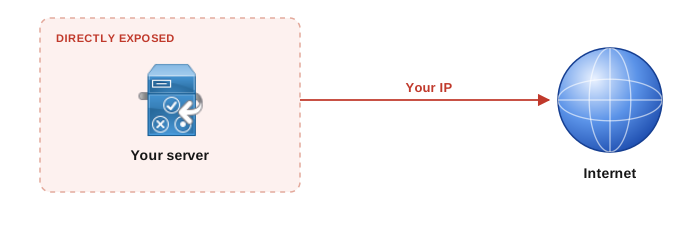
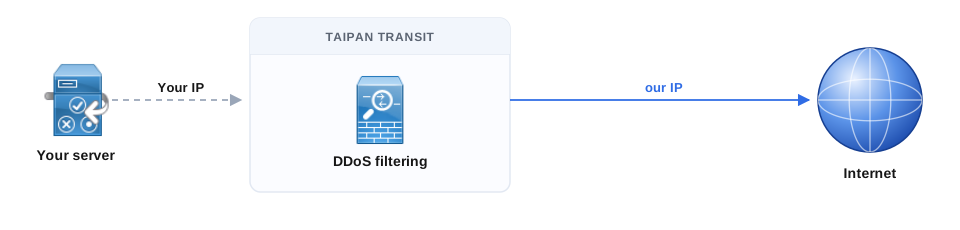
Routing through Taipan Transit. An address you route through us is announced from our network, not yours. Traffic is filtered before it ever reaches your tunnel endpoint, so volumetric attacks hit our edge instead of your uplink. The tunnel (GRE, IPsec or WireGuard) is the only thing that has to point at your actual hardware, and you can repoint it to a different server or provider in minutes without changing the public address at all. Your real connection is never in the announcement, so it's never the target.
What you gain
Addresses that survive infrastructure changes: move a service between servers, datacenters or providers by repointing one tunnel, not by touching a single DNS record. Filtering that isn't optional: traffic is scrubbed before it reaches your tunnel, so an attack against one address doesn't take down everything else behind the same connection. No exposure of your real uplink: the IP a client or attacker sees is never the one your ISP or host assigned you, it's ours, routed to wherever you decide to run the service. And growth that isn't capped by your host: most providers ration additional IPv4 heavily or price it high because they're short on space, while you can order as many routed addresses as the project needs, at 0.70€ per address per month, with nothing to justify and no minimum commitment.
Route origin and address legitimacy
Every address routed through Taipan Transit is announced under a signed ROA (Route Origin Authorization), so RPKI-validating networks can confirm the announcement is legitimate rather than dropping or flagging it. A Letter of Authorization (LOA) for an address is available on request, for cases like reverse DNS delegation or when an upstream or SSL/abuse process asks for proof you're authorized to use it.
Building a hosting platform on top of a single server
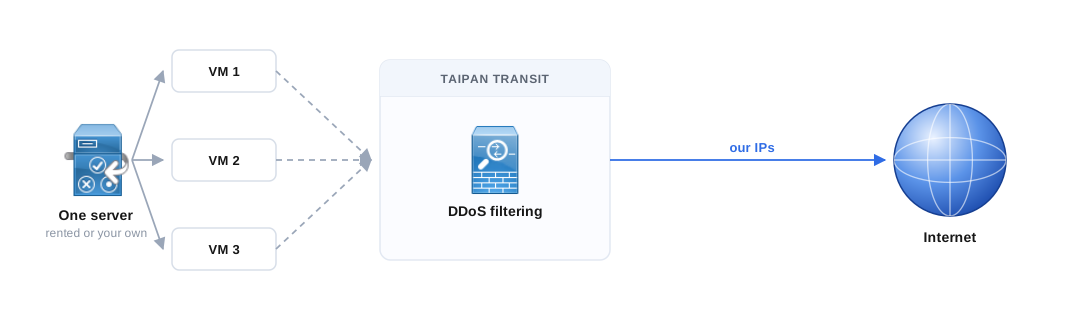
The same routing works whether the hardware is a large rented server or a machine sitting in your own rack at home. Take one big box (a Hetzner AX-class server or similar, with enough cores, RAM and bandwidth to run a dozen virtual machines) or the server you already have at home, split it into as many VMs as it can carry, and route a Taipan Transit address to each one instead of relying on whatever your provider or your home connection gives you. Providers like Hetzner hand out one IP for free and ration anything beyond that; a home connection usually gives you none at all once CGNAT is involved.
Each VM ends up with its own public IPv4, routed through the same tunnel, filtered the same way, independent of the others. What's actually running underneath is one physical machine and one tunnel; what shows up on the internet is several distinct, independently reachable servers. That's enough to host several of your own projects side by side, put a friend's service online, or build a small hosting offering of your own, all without touching the underlying hardware or waiting on a provider to hand you more addresses. The server, rented or owned, is a fixed cost either way; each additional address is 0.70€/month, so putting one more independent service online costs next to nothing beyond the address itself.
Ready to put your network online?
Once your account is verified, getting your tunnel online is sssssimple.