
An IPv4 address has no manufacturing cost and no physical existence. Whatever it sells for comes entirely from scarcity and from the willingness of other networks to route it. So the question of what one costs turns out to have no single answer, because four separate markets run at the same time, each with its own price, and the figure a buyer ends up paying depends less on the address than on which of those markets they can reach.
Bought outright, an address changed hands for around twenty dollars in the first half of 2026. Leased wholesale by the block, it runs under fifty cents a month. Rented one at a time from a cloud provider, it can cost several dollars a month for the same thirty-two bits. The gap between those numbers is not a pricing anomaly. It reflects how much of the work of making an address usable is included in each deal.
Buying outright: around $20 an address
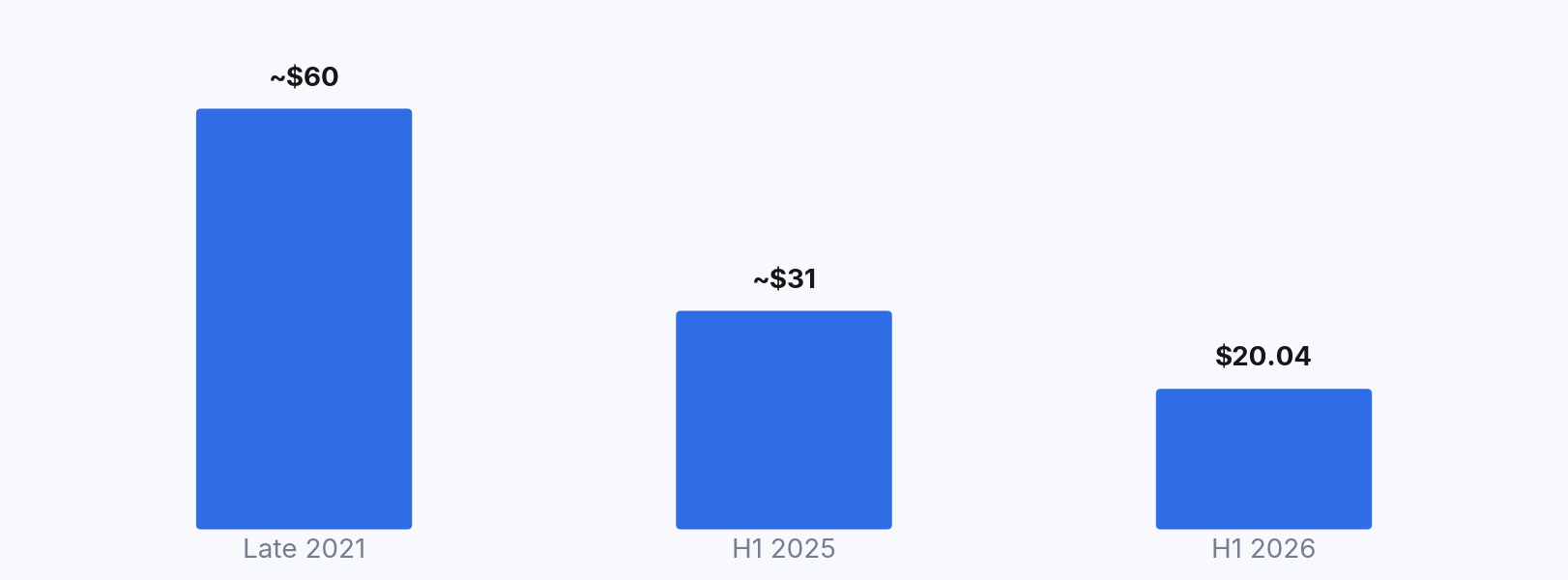
The transfer market is where organisations sell registered IPv4 space to each other, with the regional registry approving the paperwork. Prices there have fallen a long way from their peak. An analysis of first-half 2026 activity puts the average transfer price at $20.04 per address, down about 36% year on year, against a late-2021 peak of roughly $60. The lower prices did not come from a quiet market. Registry transfer logs recorded 29.7 million addresses changing hands in the first six months of the year.
Block size now works against the buyer of large space rather than for them. Broker reporting cited in the same analysis put large /16 to /18 blocks in the $13 to $16 range, while smaller prefixes commonly moved between $18 and $24. That inverts the pattern of late 2023, when the big blocks carried a premium. The likely reason is straightforward arithmetic on the demand side, since far more organisations can absorb a /24 than can write a cheque for a /16.
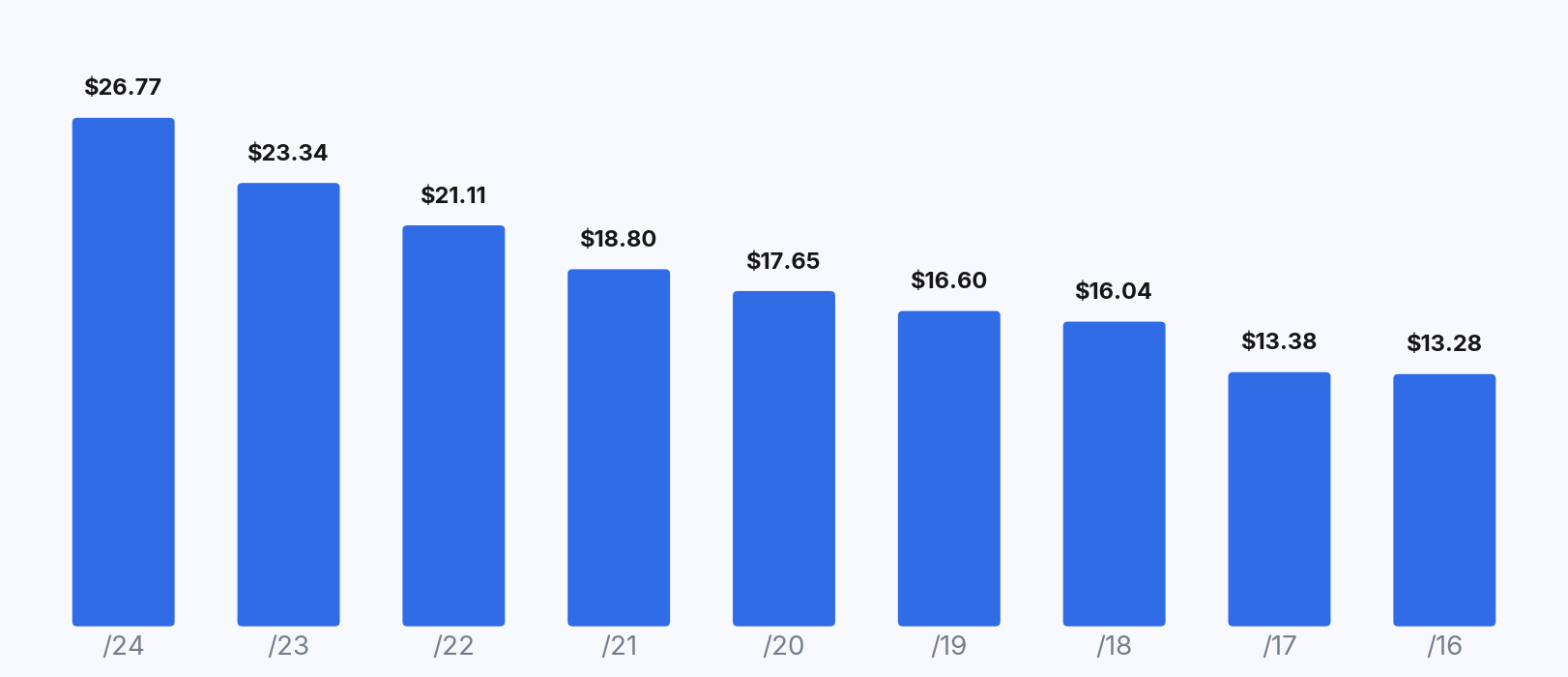
Per-address pricing is the wrong unit for a purchase decision, though, because nobody buys a single address on the transfer market. The figure that matters is the cheque for the whole prefix.
| Prefix | Addresses | Price per address | Cost of the block |
|---|---|---|---|
| /24 | 256 | $26.77 | $6,853 |
| /23 | 512 | $23.34 | $11,950 |
| /22 | 1,024 | $21.11 | $21,617 |
| /21 | 2,048 | $18.80 | $38,502 |
| /20 | 4,096 | $17.65 | $72,294 |
| /19 | 8,192 | $16.60 | $135,987 |
| /18 | 16,384 | $16.04 | $262,799 |
| /17 | 32,768 | $13.38 | $438,436 |
| /16 | 65,536 | $13.28 | $870,318 |
That table explains the shape of the market better than the per-address averages do. A /24 is a purchase a small hosting operation can actually make, which is why the small end of the ladder carries a premium and why the queue at RIPE for exactly that size runs as long as it does.
What the sticker price leaves out is eligibility. A transfer at RIPE NCC has to land in an account held by a member, so the buyer needs a Local Internet Registry membership before the address is theirs to hold. Purchased space also comes with a lock-in period. The RIPE resource transfer policy states that scarce resources, IPv4 included, "cannot be transferred for 24 months from the date the resource was received by the resource holder." Anyone treating a block as a liquid asset should read that clause first.
There is a quieter risk in buying, too. Addresses carry history. A block that spent years hosting whatever its previous owner allowed can arrive pre-loaded with blocklist entries, and cleaning that up costs time that never shows up in the purchase price.
The registry queue: €2,800 before an address arrives
The other way to hold your own space bypasses the market entirely. In the RIPE region it means opening an LIR account and joining the IPv4 waiting list, where recovered addresses are handed out in order rather than sold. RIPE NCC's published fees for 2026 are €1,800 a year per LIR plus a one-time €1,000 sign-up fee, with ASN assignments billed at €50 each.
The allocation itself is capped. Each LIR can receive a single /24, or 256 addresses, and only organisations that have never previously received IPv4 space from RIPE NCC are eligible to join the queue at all. The wait is the part worth checking before committing. RIPE's own waiting list page, updated every three hours, showed 762 LIRs in the queue at the end of August 2026, with the organisation at the front having waited 471 days. Anyone joining today should treat those addresses as a plan for a future budget year rather than a fix for a current problem.
Run the arithmetic and the registry route looks expensive at the start and cheap at the end. Sign-up plus the first annual fee comes to €2,800 before a single address has been allocated. Once the /24 arrives, the ongoing €1,800 spread across 256 addresses works out at about €7 per address per year, or roughly 59 cents a month. That is the lowest per-address figure in this article, and it comes with the heaviest conditions: eligibility, patience, an ASN, and an upstream network willing to carry the announcement.
The 59 cent figure assumes every one of the 256 addresses gets used. A /24 running at a quarter utilisation costs closer to €2.34 per active address per month, which puts it back in the same territory as retail hosting.